Grassroots Covid-19 Recovery
Building a Grassroots COVID-19 Recovery
At Community Spring, we believe the answers to our community’s problems should come from the people who are directly impacted by those problems. So when COVID-19 hit we felt compelled to act.
This crisis shed light on inequities in our broken systems that we have been feeling for a long time. The gaps that existed before are still here - only wider. How we respond to this crisis and rebuild our communities afterward must be guided by people’s experiences on a grassroots level.
The fellows in the 2020 Class paused their campaign to support people coming home from incarceration, Torchlighters Reentry Support, in order to tackle the fallout of the pandemic.
The Grassroots COVID-19 Recovery Campaign is run by Community Spring Fellows. This video was used to advertise our community-based survey to assess the needs of the community during the COVID-19 crisis.
Our vision of a grassroots recovery effort is one that is guided by the self-identified needs of community members, and responds to those needs by getting appropriate resources directly to those households.
The first step of our campaign was to conduct a survey of Alachua County residents to learn how the COVID-19 crisis has affected their lives and how they thought local institutions should respond.
229 households representing approximately 500 Alachua County residents responded. While each participant’s experience was unique, two themes emerged in the responses. First, the least well-off households were the most severely impacted by this crisis (see graph).

Second, needs are diverse. Some people were behind on rent, others were struggling to support incarcerated family members and others couldn’t afford enough food for their household. Check out our report and recommendations and watch a recording of our community forum to learn more.
CS Direct
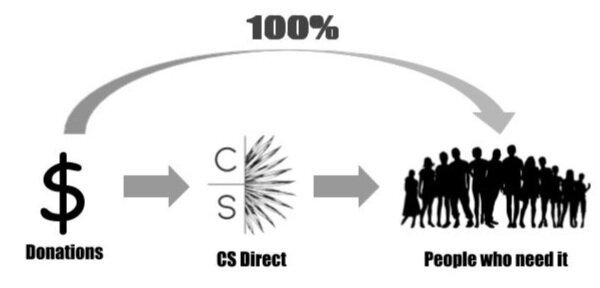
As part of tackling the fallout from the pandemic, we created CS Direct, which provided cash assistance to low-income households in Alachua County between June and October of 2020. Randomly selected households received a lump-sum payment of $300 to help meet their needs during these difficult times.
100% of donations went directly to low-income households. Payments were made without restrictions, ensuring that recipients kept their sense of agency and power to improve their lives in the way they see fit.
Why Direct Cash Relief?
The pandemic had been especially devastating for our low-income neighbors and communities of color. Results from the survey we conducted during that time made two things clear: economic resilience is low and needs are diverse.
Economic resilience is a person’s ability to withstand and recover from an economic shock. This concept is critical for understanding the challenges of living paycheck to paycheck. Our research showed that nearly half of low-income households in Alachua County were not confident that they could come up with $400 for an unexpected expense. This clearly demonstrates that many of our neighbors don’t have the resilience to handle an economic shock like COVID-19.

Our research also showed that the economic impact of COVID-19 showed up in many different ways. Some people were falling behind on the rent, while others couldn’t afford their car payments. The people facing these challenges are in the best position to determine what would be most helpful to them. Direct, unrestricted cash assistance allows them to do just that. This is not just our view, but is also supported by a number of leading foundations and nonprofits around the country.
Report back on CS Direct
Between June and October 2020, we raised $38,400 and distributed $300 checks to 128 Alachua County residents who received SNAP benefits (food stamps). Every month, depending on how much money was raised, applicants were randomly selected, verified, and hand-delivered a check with no stings attached. Recipients also received a voluntary survey to provide feedback on the experience.
Of the people who participated in the survey, 77% reported feeling that direct cash assistance without restrictions increased their power to make the best decisions for their households.

Many reported splitting the payment to cover multiple bills, especially things that they normally couldn’t get help with. 82% felt decreased stress about making ends meet that month. While everyone was grateful for assistance, we received repeated feedback that $300 was not enough to significantly increase many people’s economic stability. Several people recommended payments be increased to $600.
Other things we did
Well-being in a Time of Social Distancing
Isolation can be extremely damaging. Believe us, we know firsthand. As people who have been directly impacted by incarceration, we know the complex realities of confinement all to well.
That’s why every Thursday for two months after the stay-at-home order was issued, we held a virtual meeting for people to come and share their experiences with feeling disconnected, struggling to find resources, and anything else related to this unprecedented time.
This virtual place of healing was a space for support and community building.
Local Government Advocacy
On the day Gainesville and Alachua County declared an emergency, Community Spring acted to make sure that the needs of our low-income neighbors were a priority in our local government’s response.
We drafted and submitted a sign-on letter to local elected leaders in which 32 organizations called for a moratorium on evictions, a local fund for emergency rent and utility assistance, a suspension of public benefit terminations, and more.
We also submitted written comments and testified on GNVCares, Gainesville’s COVID-19 relief fund, advocating for additional funds to go to rent and utilities assistance for local households. And we were successful on several fronts!
Housing during Covid-19
When income and employment are uncertain, so is housing. During a pandemic, we need to do everything possible to prevent an increase in homelessness.
In addition to our sign-on letter to local elected leaders calling for a moratorium on evictions, we also published an op-ed in the Gainesville Sun calling on the Sheriff’s Office to not carry out evictions during this time of crisis.
To support these efforts, we rolled out a social media toolkit for our partners and community members. Unfortunately, when COVID-19 hit there were already hundreds of people in our community without housing.
We also worked with the Alachua County Labor Coalition and others to advocate for placing at-risk homeless individuals in vacant motel rooms.