Captive Marketplace: The Monetization of Basic Life Behind Bars
During my time in prison, my family carried a weight they should’ve never had to bear. While living on fixed incomes and stretching every dollar just to survive, they still scraped together whatever they could to add to my commissary account so I wouldn’t go without. I knew their financial situations were fragile, and every deposit they sent me came with a cost they felt at home.
But inside, their sacrifices were constantly eroded by relentless commissary price hikes. Every increase pushed me into a position where I had to ask for help more frequently. With each request the guilt grew heavier. I felt like I was a burden to the people who love me. I didn’t see it then, but I now understand that we were trapped in a system that is designed to extract as much as possible from the people who could least afford it.
Commissary Comes at a Cost
Commissary may seem like something necessary and beneficial, and in many ways it is, but at what cost?Since incarcerated individuals cannot shop in the outside world, the commissary serves as the designated place to purchase items that the facility either does not provide or provides only minimally. Typical commissary items include snacks, hygiene products, writing materials, over‑the‑counter medications, and small necessities like batteries and earbuds.
While this seems like a positive system, when we take a closer look we uncover something deeply disturbing: commissary markups are unregulated and exploitative. A markup is the extra amount added to the price of a product to determine its final selling price, ensuring profit is made to the seller. It’s the difference between what something costs in the outside world and what you’re forced to pay inside, dressed up as a privilege in the commissary store. It is what happens when a seller quietly slips their hand into your pocket and takes far more than the item is actually worth simply because they can.
Inflated prices can be found in jails and prisons throughout Florida. For example, in the Alachua County jail, everyday items are sold at extreme markups compared to their normal retail prices at the Walmart just down the street on Waldo Road:
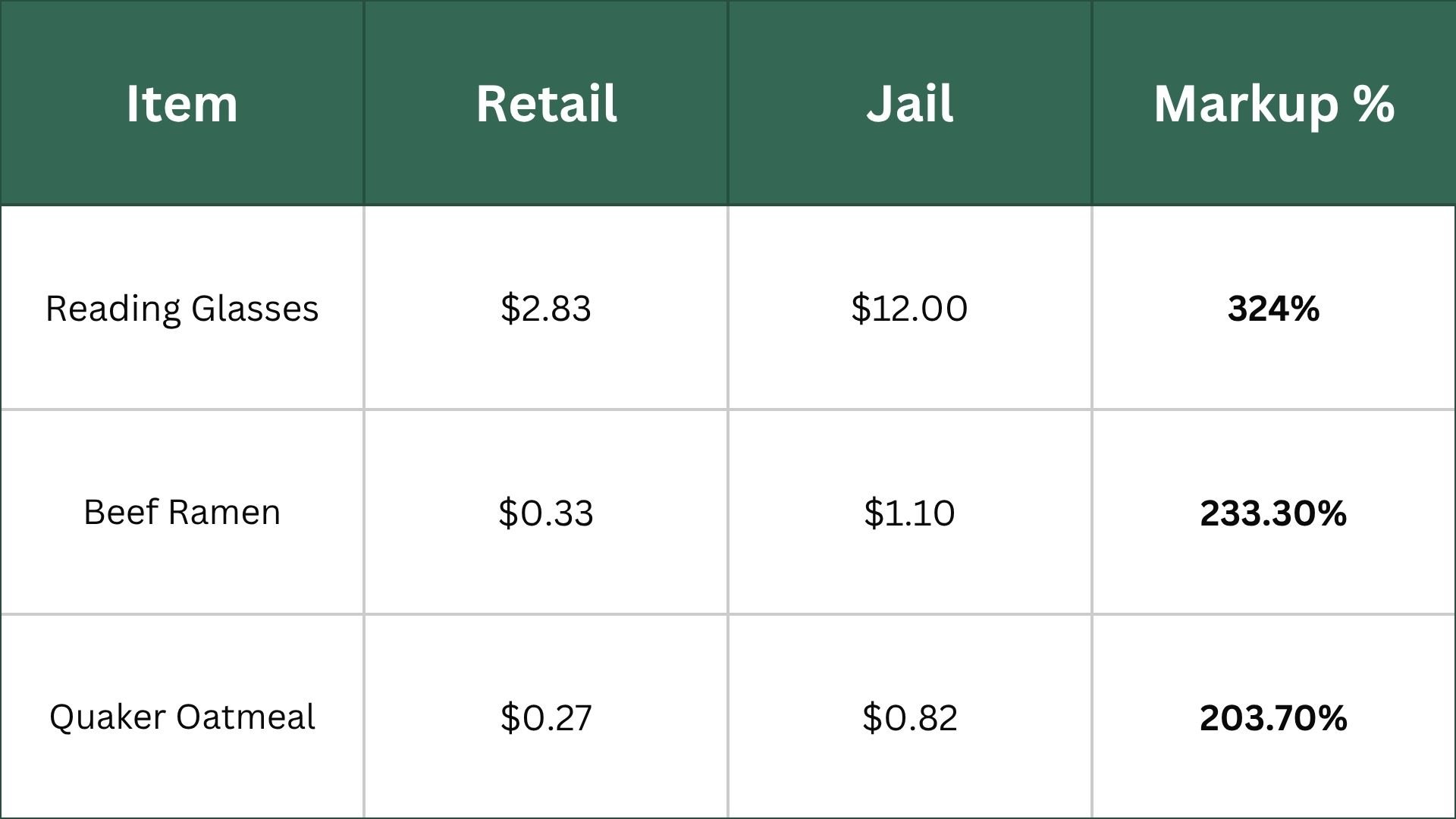
While these amounts seem small, they add up quickly. For example, if you wanted to send your loved one in the jail a care package of 20 ramen and 20 oatmeal packets, it would cost you $48.35 (including the processing fee of $7.95). At Walmart, it would cost you $12. That means every dollar you spend on your loved one is only worth a quarter.
Monopolies and Exploitation
These markups aren’t accidental, they are the result of a captive marketplace where the poorest people pay the highest prices for the most basic necessities. In jails and prisons across the nation, they're baked into a system where incarcerated people have no bargaining power, no competition to choose from, and no legal protections against predatory pricing. Families on the outside, often already struggling, end up sacrificing their household needs just so their loved ones can stay clean, fed, and connected.
As a result of these tactics, commissary has become a multi-billion dollar industry. One company that benefits from this industry is H.I.G. Capital, a global investment firm that oversees over $74 billion dollars.They specialize in taking investors’ money, and making sure those investments are lucrative. Because meals and commissary in jails and prisons are essential and can be monopolized, it’s an extremely profitable business plan to own the companies that provide those services.
The corporate structures of the industry can be complicated, but the beneficiaries are clear. Trinity Services Group and Keefe Group are two separate companies, but they are both owned by TKC Holdings, which in turn is owned by H.I.G. Through Trinity, which provides meals in the Alachua County jail, and Keefe, which runs commissary in the Alachua County jail (and the state of FL Department of Corrections through a $175 million contract), H.I.G. has built a system where incarcerated people and their families from the poorest communities, are revenue streams.
When I was in prison, I remember being excited with other inmates when we heard that the prison commissary was switching from Trinity to Keefe. We were excited because we thought we were getting new items and potentially lower prices. Looking back, we had no idea that they were both owned by the same people, TKC Holdings, which is owned by HIG!
When one company controls the quality and quantity of the food people are forced to eat as well as the commissary junk food they’re forced to rely on when that food is inadequate, there is a clear potential for a conflict of interest. And don’t worry, if you get sick from the food in the jail, you can always go see the jail’s healthcare provider, Wellpath (also owned by H.I.G.). It’s a structure that allows a billionaire company to make profit off of families from poverty stricken, economically disadvantaged communities. Incarcerated people and their families become captive markets for exploitation.

Building a More Just System
This is why commissary reform matters. One potential policy solution is placing a cap on commissary markups. A cap is a maximum amount that a product can be sold for or marked up as. Markup caps protect people from excessive and exploitative pricing. This allows the products to remain accessible while still giving the company selling the product room for profit. Some states, like California, Michigan and Nevada, are already protecting incarcerated people and their families by implementing markup caps. This means more food on the table for kids who have an incarcerated parent, more likelihood of keeping the lights on, and less strain on other basic needs for families. This also means the incarcerated have increased access to food and therefore decreased acts of violence and stress. A cap on markups is a small piece of the puzzle, but it’s significant.
When we allow incarceration to be used as a mechanism for someone else’s financial gain, we send a painful message to our community. We tell families already struggling that we are going to allow their hardship to be a revenue stream. We tell neighborhoods fighting to stay afloat that their loved ones’ suffering is someone else’s business model. We tell the most economically deprived parts of our city that their lives are worth less than the profit margins of firms that have no real connection to Alachua County. Are they not deserving of protection from exploitation?
When public institutions permit this, it is both a moral failure and a policy choice. This normalizes a system where punishment is profitable and poverty is exploited. This does not reflect the community values of Alachua County.
We invite you to stand with us as we advocate for fair commissary prices. We are lucky in Alachua County to have public officials, like the Board of County Commissioners, who care deeply about justice and fairness. My sincere hope is that we will be able to work together to alleviate this unjust financial burden on the incarcerated community and their families. Justice perishes where injustice is excused. The question is no longer whether exploitation exists. The question is whether we will allow it to continue.